


Country Mice in Paris..

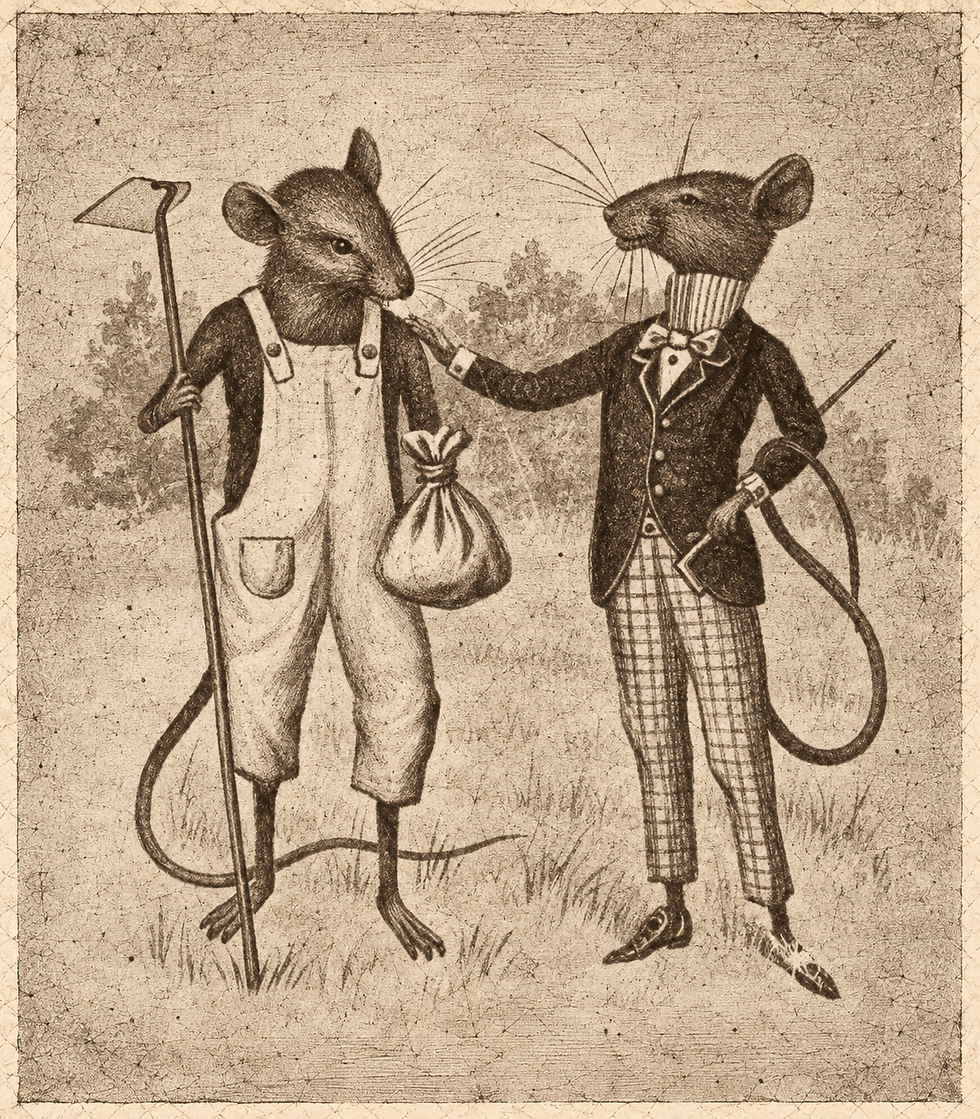
Some time ago, in these very pages, I did a great deal of confident theorising about mice. You may remember it. If not, it's in my book Postcards from the Platform's Edge - so go order a copy, if you haven't already.
There was a tear-down property for sale in L.A. and a Château for purchase in France, and somewhere between the two I set out my thesis: that the Town Mouse looks at the Château and sees lonely isolation, while the Country Mouse looks at the city condo' and sees confinement. One finds freedom in movement, the other in stillness. And both, I said, wisely, over an enormous bagel, are probably bang on.
It is a very easy thing to say when you are the Country Mouse, sitting in the stillness of nature, being right about everything. So it seemed only fair - in the interests of rigorous, amateur journalism - to test the theory.
Vanessa and I got a train to Paris.
I should explain that I have become, without entirely noticing, a genuine country mouse. Not the aspirational kind who posts about it, but the real kind, who has a tweed suit and whose daily decisions include the drama of identifying which bird is singing which song.
My ears have recalibrated. My benchmark for “a busy road” is now three cars and a man on a bike. I had, I realised somewhere around the third day of packing for a two-day trip, forgotten how to City.
Paris reminded me at once. As one exits the Gare Montparnasse, the volume simply arrives on a gust of hot wind - all of it, all at once - with no warning and certainly no apology. The e-traffic, the e-scooters, and the e-cigarettes - the impossible density of human beings all of whom seem to know precisely where they are going and see immediately that you do not.
In the countryside, sound is more of an event - something happens, and then it stops, and the quiet closes over it like water. In Paris, sound is the medium you exist in, and move through. There is no closing over. There is only the next noise, and the next, and a dog barking.
Yet while it is mildly arresting, it is also interesting. I mean our country lives are lived in department Q - for quiet. We have been in our new mid-nowhere home for four months and have yet to meet anyone talkative or interesting. So we greeted the hubbub like extra-terrestrial visitors to the planet Paris... “Look, a bus.”
Taxis have become very luxurious, almost overnight, and bicycles have bred like rabbits. Parisians walk with a benevolent purpose, but don't seem overly hurried, or depressed, like New Yorkers or anyone who lives in Finland. We underestimated the distances we chose to cover on foot by gargantuan margins of error, until our feet cried out for salvation. But it was good. It was exciting.
City streets do ask you to keep up a bit. We tend to walk quite slowly around the woods where we live, as we like to notice, and breathe it all in. Keeping up, in Paris, is a skill that is very easy to lose. Like doing a handstand. You think you are more than capable of it, until you realise that you are not. I also had the wrong shoes on.
And then, sometime in the afternoon, it happened. The city did the thing the city does.
We were in the Rue de Bretagne, up in the Marais, a lovely tangle of streets in the 3rd arrondissement where everything is four hundred years old and also, somehow, extremely happening.
We were sat outside a café with small, boisterous espressos, and we watched. That's all. We watched Paris go by - the couples, the dogs, the models and the misfits. It is an electrifying pleasure to people-watch. It is a most gratifying theatre where you can add situational commentaries to every passer-by and attach thought bubbles to all and sundry, like gum on a shoe. The City is a show that never closes, and for the price of a coffee, you get the best seats in the house.
I felt closer to my grown-up kids, for about fifteen minutes.
They are town mice, my lot, and I have written before, a touch mournfully and perhaps scornfully, about how they are unwilling to come and visit us in any country Château-rental in which I reside. They claim jobs to serve and kids to manage, expensive coffees to consume and friends to hang out with, and I have generally cast this as a mild tragedy - totally theirs, obviously, for missing out on all my birdsong and moss-covered logs.
But sitting there in the haut-Marais, I got it.
Not intellectually. I have always understood why people live in cities. I'm not a total idiot. I mean I suddenly remembered the feeling of it.
There are people everywhere. Things are open. Somebody somewhere is making lunch that smells of butter and walnuts. You can turn left instead of right for no reason whatsoever and stumble across a shop that just sells artisanal shoe-horns. There are exhibitions you haven't seen, restaurants you can't afford, people you'll never meet and entire streets going about their business without the slightest concern for whether you are wearing matching socks. Which, it was pointed out, I was not.
There is an enormous pleasure in being surrounded by lives that have absolutely nothing to do with your own. Perhaps that's what I'd forgotten.
In the countryside, your world becomes wonderfully specific. You know which field grew what in it, which dog belongs to which garden, when the swallows will be gone, and where the baker lives. The smallness is part of its charm. Life becomes detailed. Days have receipts. Paris does the opposite. It reminds you just how much is going on without you.
And oddly, instead of making me feel insignificant, for those two days it made me feel rather free.
We walked as we talked. We bought things we hadn't intended to buy. Vanessa disappeared into shops and I looked in other shops. We sat at tables too close to other tables and became temporarily involved in the lives of people we would never see again. We got lost. It got late. We couldn't decide what to eat. We criticised Italy. We lived in the moment.
Nothing particularly important happened - and perhaps that is what I liked most.
We just lived there for two days.
My feet stopped moaning and I stopped staring at buses. I knew roughly where the Seine was at all times, and could side-step oncoming pedestrians like a Welsh rugby star. I had, in other words, remembered how to City...
And then it was time to leave.
At Montparnasse, we got on the train and Paris began undoing itself through the window.
Buildings became suburbs, suburbs became warehouses, warehouses became fields. The gaps between things grew larger. Then the gaps became the thing.
I could feel myself changing speed with the landscape.
By the time we got home, it was dark. There were no taxis outside. No scooters. No sirens. Nobody selling mustard.
Just the house, the trees and that extraordinary country silence that isn't really silent at all once your ears have remembered how to hear it.
I stood outside for a moment.
Crickets. Stars. An owl. Or was it?..
It was lovely. Paris had been lovely too.
I don't know that there's much more to say about it than that. Except perhaps that my grown-up kids make slightly more sense to me.
For now...
On Platform 13, wholeness isn’t found - it’s remembered. Because loss is loss, worthiness is universal, and no one is alone. We are all in this together.


Comments