


When Food Leaves Home
- Jul 20
- 5 min read
Updated: 2 days ago
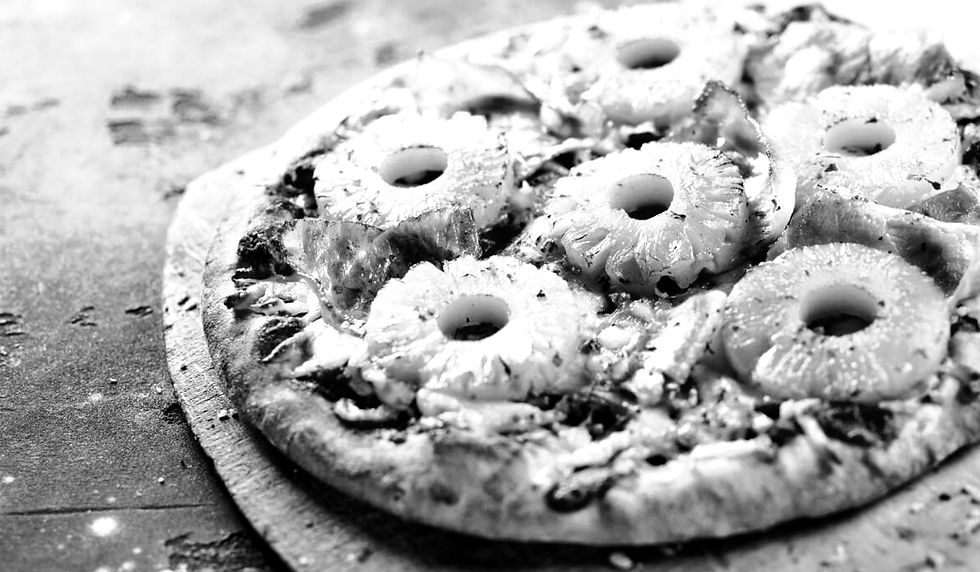
An exhausted pizzaiolo, weeps softly in the dim light of a kitchen corner. Floury head, in floury hands. The culinary heritage that was boyhood, manhood and his very lifeblood, just died on the table...
Gone now, but ever-remembered - the classic beauty of what he called pizza - the disciplined, ascetic stretch of dough, frugally flavoured with a thick slap of tomato salsa, hand-torn mozzarella; perhaps a lean slice of local ham and a leaf or two of basil - in and out of a furnace in ninety seconds flat.
It had been years since his beloved Pizza had waved goodbye to Napoli - off to see the world. And boy... did she ever?.. Returning home and waving a passport covered in more ink stamps than Yakuza gumi. The pizza reappeared as a truly global dish - but to real Italians - she came home changed. Like a painted drag queen. Shambled in the shoddy finery of pineapple, pistachios, fried eggs and pulled pork.
This is what happens when food leaves home. It travels light - a carry-on of ingredients - a good idea, in great shape. Until in every place it lands, across every border it wanders, some bright spark adds something. A little bit of local flavour here. A regional garnish there. Until, several youth hostels later, the once authentic travelling dish of food, is nothing more than a near-edible mess, bearing little resemblance to its passport photo.
Take the ubiquitous Caesar Salad - which, before we go further, is neither Italian, nor is it named after Caesar - at least not the one you are thinking of. It came to pass in Tijuana, Mexico, on the 4th of July, 1924, invented by an Italian immigrant named Cesare Cardini, who ran a restaurant across the border to serve Americans fleeing Prohibition.
The story goes that it was a busy old Independence Day, folk were thirsty, and the kitchen was running low - Cardini simply threw together what was left in his ice box.
What rose from the re-hashes, was almost monastic. Whole leaves of romaine. Good olive oil. A coddled egg yolk. Parmigiano cheese. A little Worcestershire. Lime. A slice of toasted baguette. A Magnificent Seven of ingredients - and - it was meant to be eaten with the fingers, leaf by leaf, held by the stem. That was the entire dish. Elegant, in its absolute sufficiency.
Note what is not on that list. No chicken. No bacon. No Mayo. Not even in the next postcode. And no anchovies, my friends, not a one. Cardini couldn't bear them. They swam in much later - in the 1950s - once Cardini's creation had, in the words of one food historian, "spread beyond its original creator's control".
We tend to think of a nation's signature food staples as fairly ancient and very fixed, sprung fully formed from the soil. Yet almost none of it is. Most of what we think of as deeply, essentially French, or Italian, or English, is an immigrant that arrived, was adopted, was quietly transformed, and then had its papers backdated. And no dish tells that story more beautifully, or with more wounded national pride, than the one the French would go to war over: the croissant... What?..You cry...
"You heard...", I respond. The croissant, that flaky crescent that is France — that sits beside the little cup of coffee in every film ever set in Paris — is not French.
It is Austrian. And it goes by the name of Kipferl.
Even the French still place it under the umbrella of "Viennoiserie" - that which comes from Vienna - which refers to all things that sit at the bus stop between bread and pastry BUT - that are elevated and enhanced with blankets of barely salted butter.
This factoid is not something the French are wild about, nor are they overly keen on the story spreading beyond the village walls, but the saving grace is this. The kipferl is a bready, dense, nutty, sugar-covered distant cousin of what we know and love today in croissanty France. So here lies the magic...
In late 1838, an Austrian baker called August Zang - which is such a great name, it should immediately be declared a Summer bank holiday - opened a Viennese bakery on the Rue Richelieu in Paris, offering, amonst other delights, the rather Teutonic and muscular Kipferl. The Parisiens took a shine to it, but as they have already done with comedy, cars and custard, they made it just a bit more French. They added butter. And air. And gave it a soul.
And this, I think, is the whole secret of what should happen when food leaves home. The successful runaway doesn't just let itself get mugged and messed with. It allows in a process of what I am going to term as substantive transformation. It keeps the silhouette of where it came from and takes on key elements of the essence and heritage of where it landed.
If this doesn't happen - if food leaves home and finds no one to transform it with any care. It doesn't evolve. It just accumulates. Every kitchen it passes through adds one more thing it never asked for: pineapple, marshmallows, chicken, ranch dressing... until the light, finger-held original lies soggy on the plate or drowned at the bottom of the bowl.
And here is where I have to be honest about why any of this stirs me, because it is not really about orphaned Austrian pastries.
It is because I, too, left home.
I am, if we are being prosaic about it, a kind of kipferl. I set out from one place, carrying the general shape of me - the accent, the habits, the love of butter and BB guns - and I landed somewhere else entirely - Asia, Australia, Indonesia, Italy - and most recently a corner of rural France, and the place has been quietly laminating me ever since. Folding itself into me, layer by layer, until I am not quite the thing that left and not quite the thing that landed here, but some third thing, made in the crossing. I kept my silhouette. I freed my soul. And I really like how it's turning out...
The pizzaiolo in Naples is still weeping, of course. He thinks the pineapple is act 1 of a much longer tragedy. But I am not sure it is as bad as he imagines. I think it might just be the sound of something leaving home travelling, landing, being changed by strangers, and, if it is very lucky, becoming beloved somewhere that was never expecting it.
Which is, when you think about it, the most any of us can hope for.
On Platform 13, wholeness isn’t found - it’s remembered. Because loss is loss, worthiness is universal, and no one is alone. We are all in this together.


Comments